
Saskatoon Dental FAQ: Answers to Common Dental Questions
Have a dental question? Start here. We’ve answered the things patients ask us most often about emergencies, cleanings, children’s dentistry, orthodontics, implants, root canals, CDCP coverage and more.
Find the answer you need
You shouldn’t have to dig through several pages to get a straight answer. Use the search box below or browse the questions by topic. When a question needs an exam to answer properly, we’ll tell you that too.
Last updated: October 3, 2026 · Willowgreen Dental, Saskatoon, Saskatchewan
New Patients & General Dental Care
Starting with a new dental clinic? These are the questions we hear most often from new and returning patients.
01 Is Willowgreen Dental accepting new patients in Saskatoon?
Yes. Willowgreen Dental is welcoming new patients in Saskatoon. If you’re looking for a new dental home, you can contact the clinic and the team will help you book the type of appointment that makes sense for you.
You can also meet our dentists or request an appointment before your first visit.
02 What should I look for when choosing a dental clinic?
A good dental clinic should make it easy to understand your options, ask questions and feel comfortable with the care you’re receiving. Location, appointment availability, the services offered and the experience of the dental team are all worth considering.
If you’re comparing clinics, our guide to choosing a dentist in Saskatoon gives you a practical checklist.
03 Do I need a referral to book a dental appointment?
No referral is usually needed for a regular appointment at Willowgreen Dental. You can contact the clinic directly for exams, cleanings, children’s dentistry, cosmetic consultations, emergency concerns and many other services.
If your condition is better managed by a specialist, your dentist can discuss that with you after an assessment.
04 Can I switch dentists and transfer my dental records?
Yes. You’re free to change dental clinics, and your previous records or X-rays can often be transferred if they’ll be helpful for your ongoing care.
If you’re moving to Willowgreen Dental, give the office a call before your first visit and the team can let you know what information would be useful to send over.
05 Does Willowgreen Dental offer walk-in or same-day dental appointments?
Same-day appointments may be available depending on the schedule and how urgent your concern is. It’s best to call before coming to the clinic so the team can understand what’s happening and let you know the soonest appropriate option.
If you’re dealing with pain, swelling or an injury, see our emergency dentistry information.
06 What happens at a first appointment with a new dental clinic?
Your first visit is a chance for the dental team to learn about your health history, any current concerns and what you’d like help with. The exact visit can be different for someone coming in for routine care than for someone with pain or a specific treatment question.
Our guide to a first dental appointment at a new clinic explains what you can expect and how to prepare.
07 Where is Willowgreen Dental located?
Willowgreen Dental is located at #104 – 1848 McOrmond Drive, Saskatoon, SK S7S 0A5, in the Willowgrove area.
Visit the contact page for directions, clinic hours and appointment information.
Emergency Dentistry
Tooth pain and dental injuries can be stressful. Here’s how to tell when to call and when a situation may need urgent medical care.
08 What counts as a dental emergency?
A dental emergency is usually something that needs prompt attention because of significant pain, swelling, bleeding, trauma or a risk of losing a tooth. A knocked-out tooth, severe toothache, facial swelling or a badly broken tooth are common examples.
If you’re not sure whether your problem is urgent, call the clinic. You can also review our emergency dentistry page.
09 Does Willowgreen Dental offer emergency dentist appointments in Saskatoon?
Yes. Willowgreen Dental provides emergency dental care in Saskatoon, with appointment availability depending on the clinic schedule.
If you’re in pain or have injured a tooth, call (306) 955-2400 and explain what happened. The team can help you figure out the next step.
10 Is Willowgreen Dental a 24-hour emergency dentist?
No. Willowgreen Dental does not advertise 24-hour or 24/7 dental service. The clinic’s regular hours are Monday to Wednesday 7:30am–4:30pm, Thursday 9:00am–5:30pm, and Friday 7:30am–3:00pm.
If you have serious facial trauma, uncontrolled bleeding, or swelling that is affecting your breathing or swallowing, seek urgent medical care rather than waiting for the dental office to open.
11 When does a toothache need urgent dental care?
A toothache deserves prompt attention when the pain is severe, keeps getting worse, wakes you up, or comes with swelling, fever, pressure or pain when biting. Even a milder toothache that doesn’t go away should be checked.
Because tooth pain can have several causes, the only way to know what’s going on is to have the tooth examined. Our severe toothache guide explains what to do while you’re waiting to be seen.
12 What should I do if a filling comes out or a tooth breaks?
Call a dentist as soon as you can, avoid chewing on that side and keep the area clean without poking at it. A lost filling or broken tooth isn’t always an emergency, but it can become more painful or difficult to restore if it’s left too long.
For a lost filling, see when a missing filling needs urgent care.
13 When should dental pain be treated at a hospital emergency department?
Most tooth problems are best treated by a dentist, but some situations need medical emergency care. Go to an emergency department for serious facial trauma, uncontrolled bleeding, or swelling that is making it hard to breathe or swallow.
If the problem is mainly tooth pain without those warning signs, contact a dental clinic as soon as possible.
Preventive Dentistry, Exams & Cleanings
Wondering how often to come in, whether cleanings hurt, or why X-rays are needed? These answers cover the basics of preventive care.
14 How often should I have a dental exam and cleaning?
There isn’t one schedule that works for everyone. How often you should come in depends on your gum health, cavity risk, past treatment and how much buildup tends to develop between visits.
Your dentist and hygienist can recommend a schedule that fits your mouth rather than relying on a one-size-fits-all interval. Learn more about preventative dentistry and dental cleanings.
15 How much time should I allow for a dental cleaning?
The time needed for a cleaning can vary quite a bit. Someone with light buildup and healthy gums may need less time than a patient who has heavier tartar, gum inflammation or other areas that need extra attention.
If you’re planning your day around the appointment, our guide on how long a dental cleaning takes goes into more detail.
16 Does professional teeth cleaning hurt?
For many people, a routine cleaning is comfortable. You may notice some tenderness if your gums are inflamed, your teeth are sensitive or there is heavier buildup around certain areas.
Let your hygienist know if anything feels uncomfortable. They can slow down, adjust the technique and work with you to make the visit easier.
17 Can I eat after a dental cleaning?
Usually, yes—but it can depend on what was done during the visit. If fluoride or another product was applied, you may be asked to wait before eating or drinking.
Follow the instructions you’re given at the appointment, or read our guide to eating after a dental cleaning.
18 Do adults ever need fluoride treatment?
Yes. Fluoride isn’t only for children. Some adults may benefit from professional fluoride if they have a higher cavity risk, exposed root surfaces, dry mouth, sensitive teeth or areas of weakened enamel.
Your dental team can tell you whether it would be useful in your situation. Learn more about fluoride treatment.
19 Who can benefit from dental sealants?
Sealants are most often used on teeth with deep grooves that are hard to keep clean—especially children’s permanent molars. In some cases, adults with suitable teeth may benefit as well.
The dentist will look at the tooth surface and cavity risk before recommending them. See our dental sealants page for more information.
20 Why are dental X-rays sometimes needed?
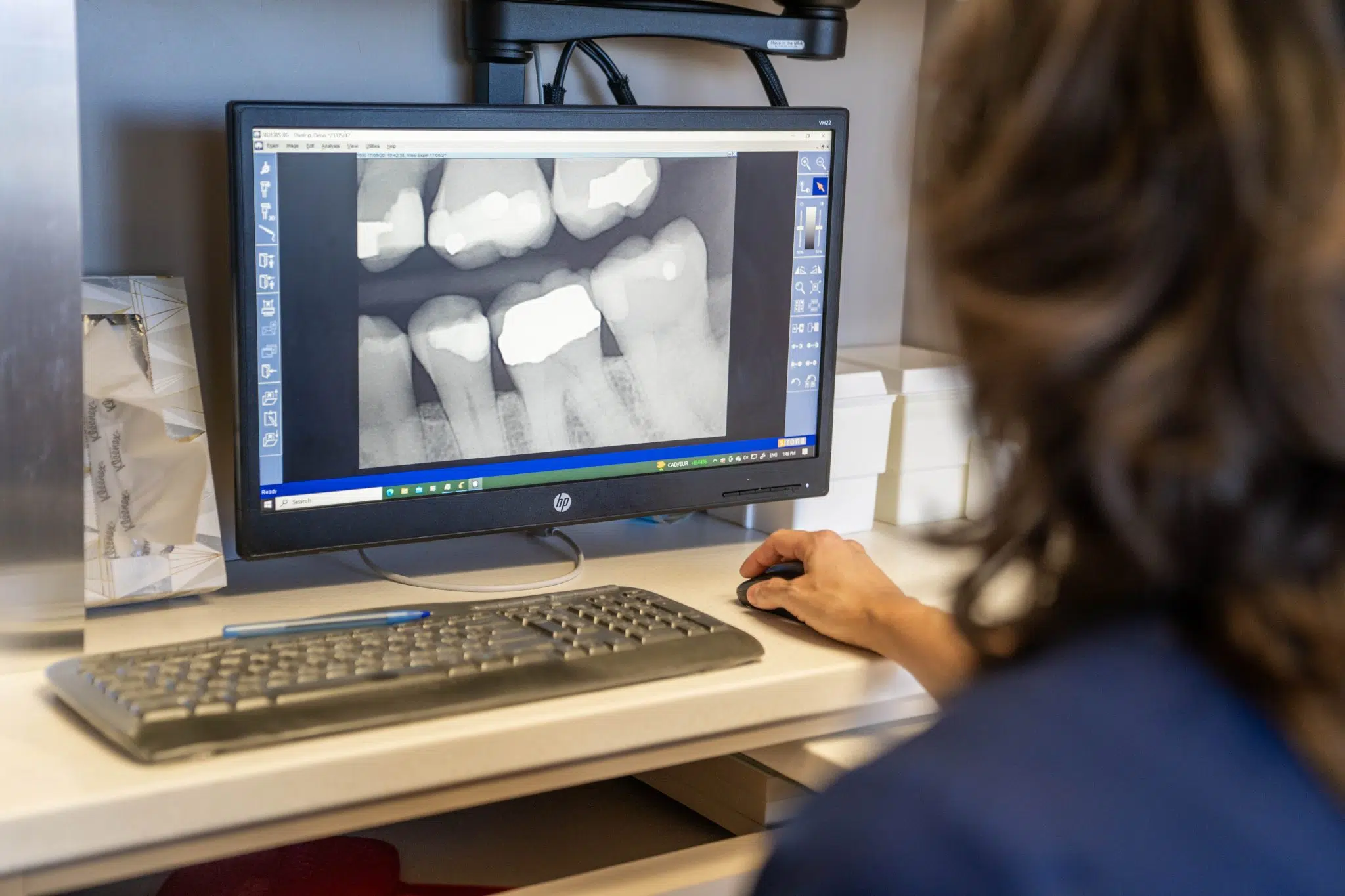
X-rays help your dental team see areas that can’t be checked properly just by looking in your mouth. They may be used to assess the spaces between teeth, roots, bone levels, developing teeth and other structures.
Willowgreen Dental uses digital dental X-rays, and your provider will decide when imaging is useful for your care.
21 Why is oral cancer screening part of a dental exam?
During an oral cancer screening, your dental provider looks for changes in the mouth and nearby tissues that may need a closer look. Many early changes aren’t painful, which is one reason screening can be valuable during routine care.
A screening doesn’t diagnose cancer on its own. If something looks unusual, further assessment or referral may be recommended. Learn more about oral cancer screening.
22 Should I use a custom sports mouthguard or a night guard?
They’re made for different jobs. A sports mouthguard is designed to help protect your teeth and soft tissues during athletic activity, while a night guard may be recommended for some people who clench or grind their teeth.
See our night guard vs. sports guard guide or visit the mouthguards page.
Children's Dentistry
Parents ask great questions. Here are straightforward answers about first visits, early tooth loss and preventive care for children.
23 When should my child have their first dental visit?
A good time for the first dental visit is within about six months of the first tooth appearing, or by age one. Early visits are usually simple and give parents a chance to ask questions about brushing, feeding habits and what to expect as more teeth come in.
Our children’s dentistry page explains how we approach dental visits for younger patients.
24 Does Willowgreen Dental provide children's dentistry in Saskatoon?
Yes. Willowgreen Dental provides dental care for children as part of its general dental practice. Visits can include preventive care, monitoring growth and development, and treatment when a dental problem comes up.
If a child needs care that is better suited to a pediatric dental specialist, referral options can be discussed.
25 How can I make my child's first dental visit easier?
Keep it simple and positive. You don’t need to explain every detail in advance—just let your child know that the dental team will count and check their teeth. Try to avoid scary words or sharing negative dental experiences of your own.
Our guide to preparing a child for their first dentist visit has more tips.
26 What happens if a baby tooth is lost too early?
Sometimes nothing more is needed, but losing a baby tooth early can affect the space available for the adult tooth that will eventually replace it. The dentist will consider your child’s age, the tooth involved and how the permanent teeth are developing.
In some cases, a space maintainer may be recommended.
27 Are fluoride and dental sealants only for children?
No. Both are commonly used in children’s preventive care, but adults can benefit from them too in the right situation. It depends on cavity risk, tooth shape, gum recession and other individual factors.
Read more about fluoride treatment and dental sealants.
Cosmetic Dentistry
Thinking about whitening, bonding or veneers? These answers can help you understand what each option is for before you book a consultation.
28 What is cosmetic dentistry?
Cosmetic dentistry focuses on improving the appearance of your teeth or smile. Depending on what you’d like to change, that might involve whitening, bonding, veneers, crowns or treatment that changes tooth alignment.
The right option depends on the health of your teeth as well as the look you’re hoping to achieve. Explore cosmetic dentistry at Willowgreen Dental.
29 How much does professional teeth whitening cost in Saskatoon?
Whitening fees can vary depending on the whitening method and what’s appropriate for your teeth. Rather than giving a generic online price, the clinic can confirm the current fee and explain which option is being recommended.
Visit our teeth whitening in Saskatoon page or contact the office for current pricing.
30 Can professional teeth whitening cause sensitivity?
It can. Temporary sensitivity is one of the more common side effects of teeth whitening, although some people notice very little and others feel it more strongly.
If you already have sensitive teeth, cracks, decay or exposed root surfaces, it’s worth having those checked before whitening so you can choose an approach that makes sense for your mouth.
31 What is dental bonding used for?
Dental bonding uses tooth-coloured resin to repair or reshape selected areas of a tooth. It can be useful for some small chips, gaps, uneven edges or other cosmetic concerns.
Whether bonding is a good fit depends on the tooth, your bite and how much change is needed. Learn more about dental bonding.
32 How much do dental veneers cost?
There isn’t one set price that fits every veneer case. Cost depends on how many teeth are being treated, the material used, the amount of preparation needed and the overall treatment plan.
A consultation is the best way to get an accurate estimate. You can start with our dental veneers page.
33 How do I know whether bonding or veneers are a better fit?
It depends on what you want to change and how much treatment the tooth needs. Bonding is often more conservative, while veneers may be considered when a larger or more durable cosmetic change is desired.
Your dentist will also look at bite forces, existing fillings, enamel, tooth position and long-term maintenance before recommending one over the other.
Orthodontics, Invisalign & SureSmile
Clear aligners and orthodontic treatment come with plenty of questions. Here are the ones patients ask us most often.
34 Does Willowgreen Dental provide orthodontic treatment in Saskatoon?
Yes. Willowgreen Dental provides orthodontic treatment options through its general dental practice. The first step is an assessment to look at tooth alignment, your bite and the kind of changes you’re hoping to make.
Visit our orthodontics in Saskatoon page to learn more.
35 How are clear aligners different from traditional braces?
Clear aligners are removable trays, while traditional braces stay attached to the teeth with brackets and wires. Aligners are less noticeable and can be removed for eating and brushing, but they need to be worn consistently to work as planned.
Some tooth movements are also better suited to one approach than another. Our Invisalign vs. braces guide compares the two in more detail.
36 Does Willowgreen Dental offer Invisalign in Saskatoon?
Yes. Willowgreen Dental offers Invisalign as one of its clear-aligner options. A consultation is needed to see whether Invisalign is suitable for your teeth, bite and treatment goals.
Learn more about Invisalign in Saskatoon.
37 What is SureSmile clear aligner treatment?
SureSmile is another clear-aligner system that uses a planned series of removable trays to move the teeth over time. Like any orthodontic treatment, it starts with an assessment to make sure the approach fits your needs.
See SureSmile in Saskatoon or read what to expect at a SureSmile consultation.
38 Can dental insurance help pay for braces or orthodontic treatment?
Sometimes. Some dental plans include orthodontic benefits, while others do not. Even when coverage is included, there may be age limits, lifetime maximums, waiting periods or a percentage that you still pay yourself.
Check your plan before starting treatment, and see our guide to dental insurance and braces in Canada.
Root Canals, Crowns & Restorative Dentistry
If you’ve been told you may need a root canal, crown or other restorative treatment, this section explains the common questions in plain language.
39 What is endodontic treatment?
Endodontic treatment deals with problems inside a tooth, where the dental pulp and nerves are located. Root canal treatment is the procedure most people associate with endodontics.
It may be recommended when the pulp is inflamed, infected or too damaged to stay healthy. Learn more about endodontic care at Willowgreen Dental.
40 How can I tell if I might need a root canal?
Persistent tooth pain, pain when biting, lingering sensitivity to hot or cold, swelling, or a badly damaged tooth can all be signs that the pulp may be involved. That said, symptoms alone can’t confirm whether you need a root canal.
A dental exam and, when appropriate, X-rays are usually needed to find the cause and decide on treatment.
41 Does Willowgreen Dental provide root canal treatment in Saskatoon?
Yes. Willowgreen Dental provides endodontic care, including root canal treatment when it is appropriate for the tooth and the case.
The dentist will first assess the tooth and explain whether root canal treatment, another option or a specialist referral makes the most sense. See our endodontics page.
42 How much does a root canal cost?
Root canal cost depends on which tooth is being treated and how complex the case is. A molar, for example, can have more canals than a front tooth, and the tooth may also need a crown or another restoration afterward.
The clinic can give you a treatment-specific estimate once the tooth has been assessed.
43 When is a dental crown recommended instead of a filling?
A crown may be recommended when too much of the tooth is damaged or weakened for a filling to provide reliable support. Large old fillings, cracks, decay or previous root canal treatment can all affect that decision.
Your dentist will look at how much healthy tooth remains and how the tooth handles bite forces. Learn more about dental crowns.
44 How long does dental freezing last?
It varies. The type of local anaesthetic, where it was placed, the procedure and your own response can all affect how long the numbness lasts.
Because your lip, cheek or tongue can stay numb after the appointment is over, be careful not to bite those areas accidentally. Our guide on how long dental freezing lasts has more detail.
Oral Surgery, Extractions & Dental Implants
From wisdom teeth to implants, these treatments often involve more planning. Here’s what patients usually want to know first.
45 Does Willowgreen Dental provide oral surgery in Saskatoon?
Yes. Willowgreen Dental provides a range of oral-surgery-related procedures within its general dental practice. Whether a procedure can be done at the clinic depends on the type of treatment, your medical history and how complex the case is.
Visit our oral surgery in Saskatoon page for more information.
46 Why might a dentist recommend removing a tooth?
Extraction may be recommended when a tooth can’t be restored predictably, is badly fractured, has a severe infection, or is creating another dental problem. In some orthodontic cases, removal may also be part of the treatment plan.
Dentists generally look at whether the natural tooth can be saved before recommending an extraction. Read more about when tooth extraction may be necessary.
47 Do all wisdom teeth need to be removed?
No. If wisdom teeth are healthy, properly positioned and not causing problems, they may simply be monitored.
Removal is more likely to be discussed when there is pain, infection, decay, gum problems, impaction or damage to a neighbouring tooth. See our wisdom tooth extraction page.
48 How much does wisdom tooth removal cost in Saskatoon?
The cost can vary quite a bit depending on how many wisdom teeth are being removed, whether they are impacted, how difficult they are to access, what imaging is needed and whether sedation is part of the plan.
An examination is needed before the clinic can give you an accurate estimate. You can start by reviewing our wisdom tooth extraction information.
49 What is a dental implant?
A dental implant is placed in the jaw to support a replacement tooth or another type of dental restoration. It acts as a foundation for the part of the tooth you see above the gumline.
Planning also involves the surrounding bone, gums, bite and your overall health. Read what dental implants are or visit our dental implants page.
50 How much do dental implants cost in Saskatoon?
Implant treatment is priced case by case because there may be several parts to the process. The total can depend on the number of implants, imaging, surgical needs, grafting, implant components and the final crown or other restoration.
A consultation is the best way to get an accurate estimate for your situation. See dental implants in Saskatoon.
51 Can dental insurance help pay for implants?
It may. Some dental plans contribute toward certain parts of implant treatment, while others exclude implants or apply annual and lifetime limits.
Because every plan is different, it’s worth checking your benefits before treatment. Our guide to dental implant insurance coverage explains what to look for.
52 How do dental implants compare with dentures for missing teeth?
Both can replace missing teeth, but they work very differently. Dentures are removable, while implants are placed in the jaw and can support a crown, bridge or other restoration.
The better option depends on how many teeth are missing, bone and gum conditions, your health, maintenance preferences and budget. See our implants vs. dentures guide.
Sedation Dentistry & Myofunctional Therapy
If dental anxiety, mouth breathing or tongue posture is part of your concern, these answers can help you understand the services available.
53 Can sedation dentistry help if I feel anxious about dental treatment?
It can. Sedation may be helpful for some patients who feel very anxious, have difficulty sitting through longer procedures or have other barriers to treatment.
The right option depends on your health history, the procedure and your level of anxiety. Learn more about sedation dentistry.
54 What is myofunctional therapy?
Orofacial myofunctional therapy uses exercises and behaviour-based strategies to work on patterns involving the tongue, lips, facial muscles, breathing and swallowing.
It isn’t the same plan for everyone. Treatment starts with an assessment to understand which patterns are present and what may be contributing to them. Learn more about orofacial myofunctional therapy in Saskatoon.
55 Who provides myofunctional therapy at Willowgreen Dental?
Cierra Andreas is Willowgreen Dental’s myofunctional therapy provider. Her background includes dental assisting, an Advanced Diploma of Dental Hygiene completed with Honours, and specialized training in myofunctional therapy.
You can meet Cierra Andreas and learn more about her background.
56 Can myofunctional therapy be relevant to mouth breathing or tongue posture?
Yes. Mouth-breathing habits and tongue posture are among the patterns that may be looked at during a myofunctional assessment.
Because these concerns can have more than one cause, some patients may also need input from other health professionals. Our article on mouth breathing, tongue posture and oral health explains the connection.
CDCP, Dental Costs & Coverage
Coverage and cost questions can be confusing. These answers explain what the clinic can confirm and what depends on your individual plan or treatment.
57 Does Willowgreen Dental accept the Canadian Dental Care Plan (CDCP)?
Yes. Willowgreen Dental currently participates in the Canadian Dental Care Plan. If you’re using CDCP coverage, it’s a good idea to confirm that your coverage is active and ask whether there may be any amount you need to pay yourself.
Visit our CDCP page for clinic-specific information.
58 How much does the CDCP cover?
The CDCP can help with the cost of eligible dental services, but it does not always mean treatment is completely free. What the plan pays depends on the service, the CDCP fee schedule and whether a co-payment applies to you.
For the most accurate information, review the current federal plan details and ask the clinic about your estimated portion before treatment. Our CDCP page is a good place to start.
59 Does the CDCP cover cleanings, root canals or extractions?
The CDCP includes several categories of dental care, including preventive, restorative, endodontic and oral-surgery services, but coverage depends on the specific service and current plan rules. Some treatments may also require preauthorization.
Before treatment, ask the clinic to review the planned service with you so you understand what may be covered and what you may need to pay.
60 Why can't a dental clinic give one exact price for every treatment online?
Because the same treatment name can describe very different situations. A simple extraction is different from an impacted wisdom tooth, and one implant case may need very different steps from another.
Once the dentist knows what treatment you actually need, the clinic can give you a much more useful estimate instead of a price that may not apply to your situation.
61 Can dental expenses be claimed on Canadian income taxes?
Some eligible dental expenses may qualify as medical expenses for Canadian tax purposes, but the rules depend on the expense and your individual tax situation.
Keep your receipts and check current Canada Revenue Agency guidance or speak with a qualified tax professional. Our article on claiming dental bills on taxes gives a general overview.
No matching question found
Try another search term or contact Willowgreen Dental with your question.
Talk with Willowgreen Dental in Saskatoon
Some questions are easy to answer online. Others depend on your symptoms, dental history or a specific tooth. If you’re not sure where to start, contact the clinic and we’ll help you with the next step.