

Most Saskatoon dentists recommend applying dental sealants as soon as a child’s permanent molars have fully erupted, which is typically around age 6 for the first molars and around age 12 for the second molars. Your dentist will confirm the right timing for your child based on tooth eruption and individual risk factors.
If your child is heading back to school in a few weeks, this is a good moment to ask whether sealants are appropriate at their next check-up.
What Are Dental Sealants, Exactly?
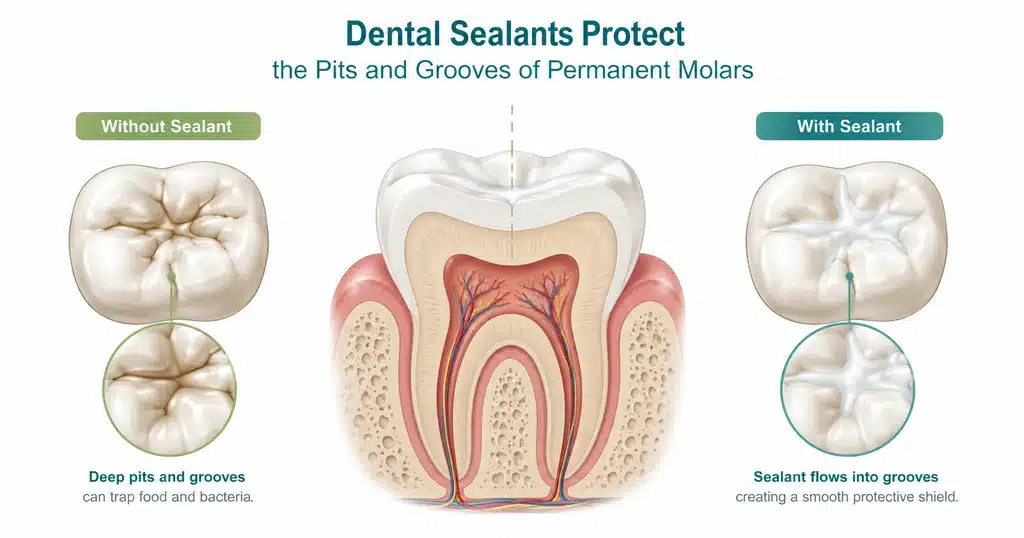
A dental sealant is a thin protective coating applied to the chewing surface of a back tooth, usually a molar or premolar. The material flows into the natural grooves and pits on top of the tooth, then hardens under a curing light. Once set, it creates a smoother surface that is easier to keep clean than the deep grooves underneath.
Back teeth have the most complex chewing surfaces in the mouth. Even with careful brushing, a toothbrush bristle often cannot reach into every groove. Sealants are one of the preventive tools dentists use to reduce that risk, alongside regular brushing, flossing, and routine dental cleaning.
Why Age Matters for Sealant Timing
Sealants work best when applied soon after a molar has fully come in, before decay has had a chance to start in those grooves. Two eruption windows matter most for most children:
• Around age 6 — the first permanent molars (sometimes called six-year molars) erupt behind the baby teeth. Because no baby tooth falls out to signal their arrival, many parents do not realize these teeth have come in at all.
• Around age 12 — the second permanent molars erupt further back in the mouth.
In some cases, a dentist may also recommend sealants on baby molars if a child has deep grooves and a higher risk of early decay. This depends on the individual child’s oral health, dental history, and the dentist’s clinical assessment during examination.
Is My Child Too Old, or Too Young, for Sealants?
There is no fixed cutoff. If a molar has recently erupted and shows no signs of decay, sealants can usually still be placed regardless of whether your child is 6, 9, or 13. The main factor is the condition of the tooth surface at the time of your child’s appointment, not a strict age range. Your dentist will assess this directly rather than relying on age alone.
What Happens During a Sealant Appointment
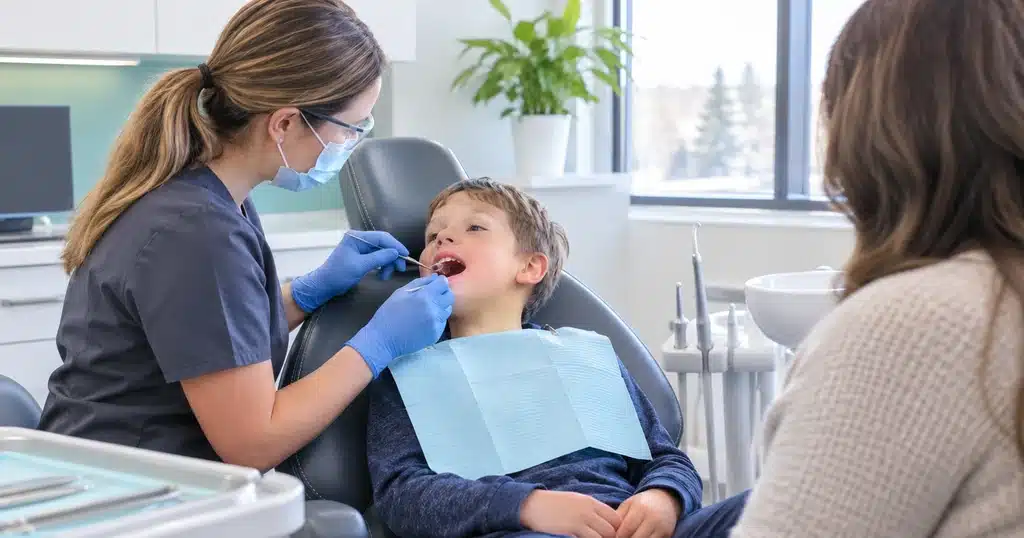
A sealant appointment is generally brief and does not typically require freezing or anaesthetic. The general process looks like this:
• The tooth is cleaned and dried.
• A mild conditioning solution may be applied briefly to help the sealant bond, then rinsed off.
• The tooth is dried again and kept isolated from saliva.
• The sealant material is painted onto the chewing surface.
• A curing light hardens the material in place, usually within seconds per tooth.
Most children tolerate the appointment well because there is no drilling and no discomfort typically associated with the procedure itself. Some children may still find it takes patience to hold still with instruments and cotton in their mouth for a few minutes.
How Long Do Sealants Last?
With regular dental check-ups, sealants can often last several years, though this varies by patient, diet, and how the sealant is cared for. Sealants can wear down or chip over time and are monitored at routine visits. If a sealant is found to be worn or missing, it can often be reapplied. Your dentist will check the condition of existing sealants as part of a preventative dentistry exam.
Do Sealants Replace Brushing and Flossing?
No. Sealants only protect the chewing surfaces of the treated teeth. They do not protect the sides of teeth between the molars, where flossing is still needed, or the front teeth, which are less prone to the deep-groove pattern that sealants address. A full oral hygiene routine, including fluoride treatment where appropriate, remains important alongside sealants.
Common Questions Saskatoon Parents Ask
Do sealants hurt?
Sealant placement does not typically require freezing, and most children do not report pain during the process. Some sensitivity to the conditioning solution or curing light is possible but usually brief.
Can sealants be applied to a tooth that already has a small cavity?
This depends on the extent of the decay. In some cases, a dentist may still place a sealant over a very early, non-progressing area to help prevent further decay. If decay has progressed further, a filling may be the more appropriate option. Your dentist will determine which approach fits your child’s specific tooth.
Are sealants covered by dental insurance or the Canadian Dental Care Plan?
Coverage varies by plan. Many private dental plans classify sealants as a preventive service, but the details differ between providers. If your family has coverage through the Canadian Dental Care Plan, speak with our team to confirm which preventive services apply to your child, since we can check this directly on your behalf.
Will my child need sealants on every back tooth?
Not necessarily. Some children have deeper grooves that put them at higher risk, while others do not. This is assessed tooth by tooth during a clinical examination, not applied as a blanket rule.
Willowgreen Dental welcomes new and returning young patients at our clinic at #104 – 1848 McOrmond Drive in Saskatoon, serving families across Willowgrove, University Heights, Evergreen, Brighton, Erindale, and Rosewood. If your child has a six-year molar or twelve-year molar that has recently come in, late summer is a practical time to book a children’s dentistry appointment before the September school schedule begins.
To ask whether sealants may be appropriate for your child, contact our team or request an appointment through our contact page.
This information is intended for general patient education and does not replace a dental examination, diagnosis, or individualized treatment recommendation. Whether dental sealants are appropriate for your child depends on a clinical examination by a licensed dentist.