
Digital Dental Impressions in Saskatoon
A More Comfortable Alternative to Putty Trays
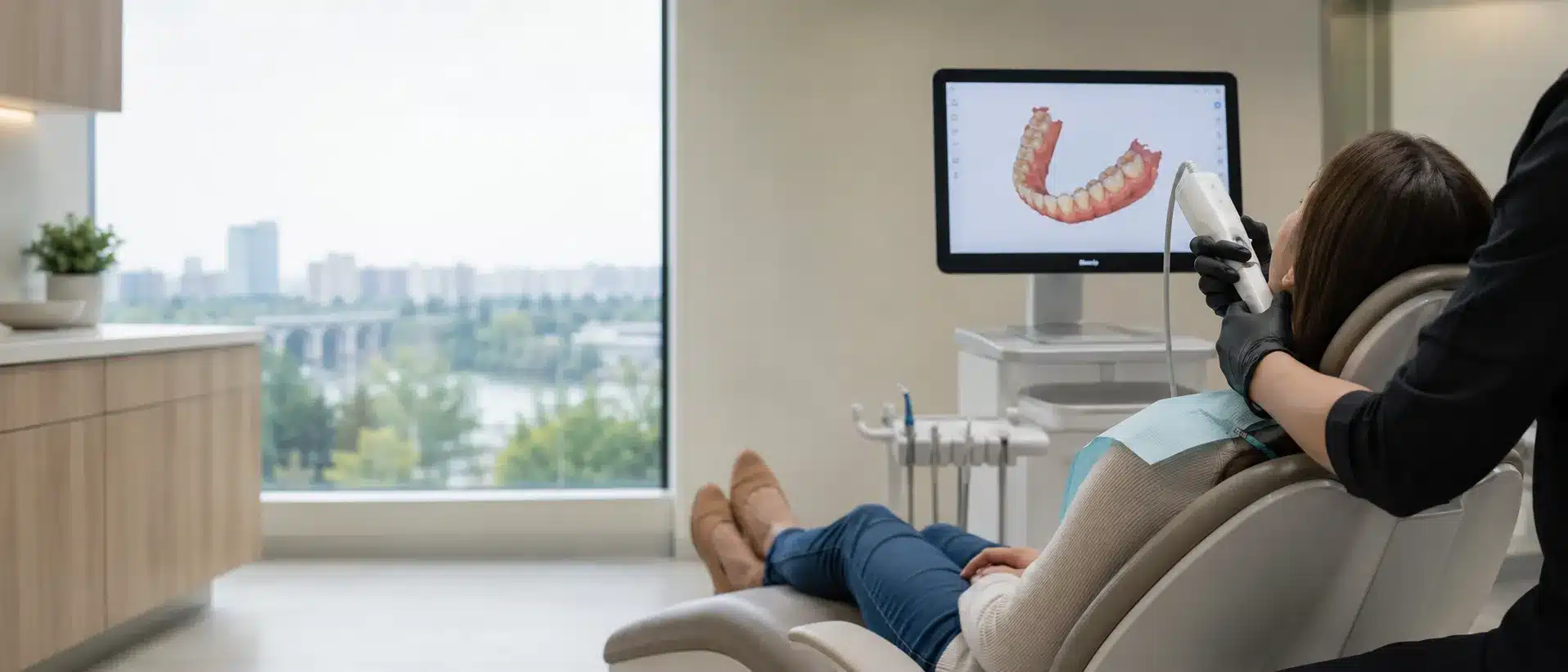
Willowgreen Dental uses an intraoral scanner to create a three-dimensional record of your teeth when it is appropriate for your treatment. The scanner uses optical light rather than ionizing X-rays, and many patients find it more comfortable than conventional impression material. Suitability and scan time vary by case.
A Different Way to Record the Shape of Your Teeth
Conventional dental impressions use a tray filled with impression material that remains in the mouth while it sets. Some patients tolerate this well, while others find the taste, pressure, or tray position uncomfortable. If an impression contains a void or distortion, another impression may be required.
A digital impression uses a small optical wand to collect images of the visible tooth and gum surfaces. Software combines those images into a three-dimensional model that the dental professional can review. If a limited area is incomplete, that section can often be scanned again. The appropriate method still depends on the treatment and clinical conditions.
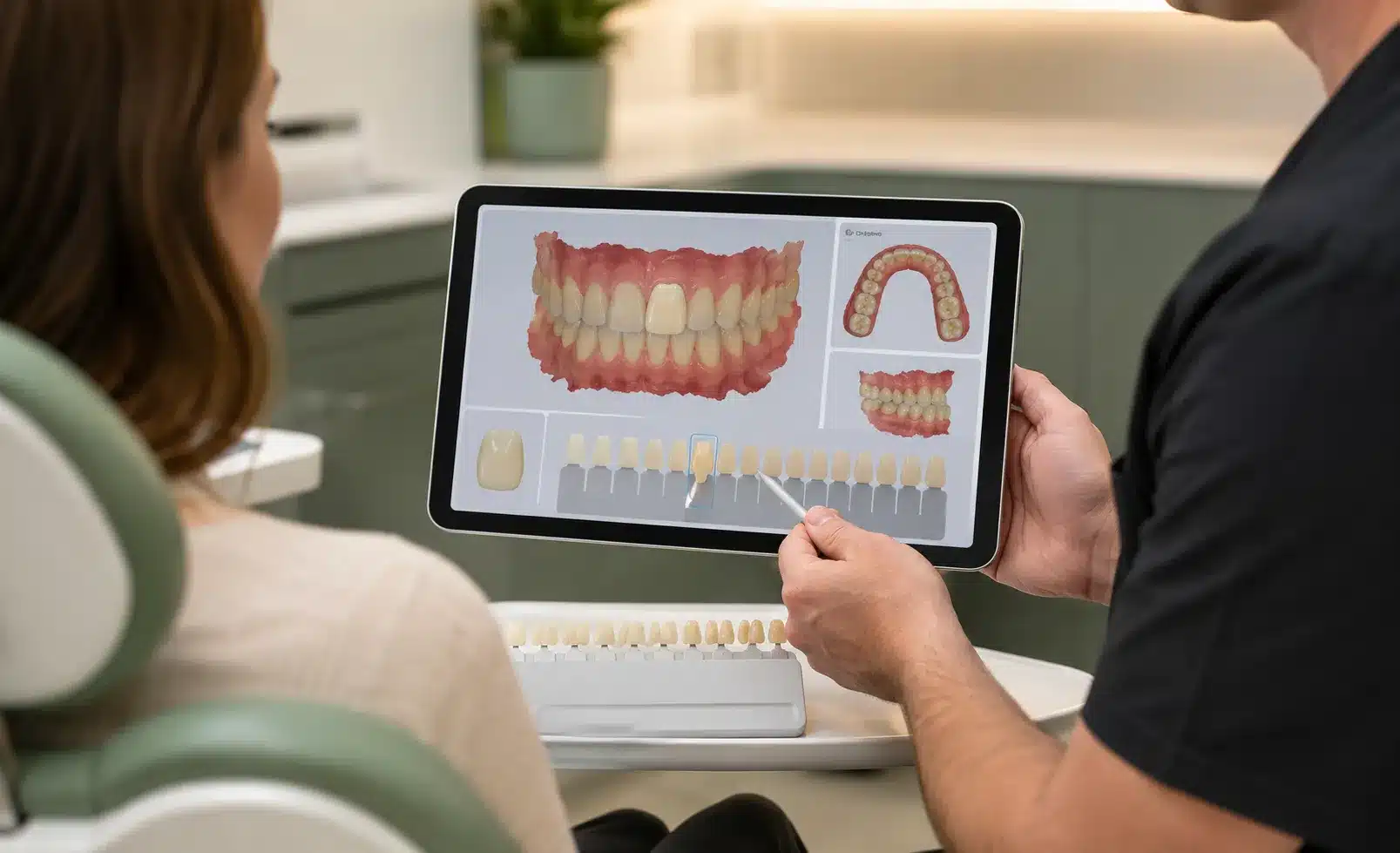
The digital model appears on the monitor as the scan is completed.
May Reduce Gagging
The smaller wand avoids a full impression tray, but individual comfort and gag-reflex responses vary.
No Ionizing X-Rays
The impression scan uses optical light. Diagnostic radiographs may still be needed for other clinical purposes.
Reviewable Digital Record
The scan can be reviewed on screen. Restoration fit also depends on preparation, design, manufacturing, and clinical factors.
Electronic Lab Transfer
Files can be sent electronically when laboratory work is required. Final turnaround depends on the restoration and laboratory.
When Digital Impressions May Be Used
Digital scanning may be used for many restorative, orthodontic, and protective appliances. Conventional impressions or additional imaging may still be appropriate in some cases. Your dentist will recommend the record that best supports the planned treatment.
| Procedure | Digital scan | Clinical note |
|---|---|---|
| Dental Crowns | Often used | Suitability depends on the preparation and ability to capture the margins. |
| Dental Bridges | May be used | The span and clinical conditions affect the selected technique. |
| Invisalign Aligners | Commonly used | The scan is one part of the orthodontic assessment and treatment plan. |
| SureSmile Aligners | Commonly used | Additional photographs, radiographs, or records may also be required. |
| Implant Planning | May be used | It may be combined with CBCT imaging and other clinical records. |
| Night Guards & Occlusal Splints | Often used | The appliance and patient’s oral condition determine the approach. |
| Orthodontic Retainers | Often used | A complete and accurate scan of the teeth is required. |
| Dental Veneers | May be used | The dentist selects the impression method for the individual case. |
Clinical examination determines whether an intraoral scan, a conventional impression, radiographs, CBCT imaging, or a combination of records is needed.
Fees and dental plan coverage vary. When digital scanning is part of recommended care, the clinic will explain how it is included in your treatment estimate. Ask your insurer about coverage for the treatment being provided.

What to Expect During a Digital Impression Scan
The exact process varies by treatment, but a typical intraoral scan follows these general steps.
The dental team prepares the scanner
When digital scanning is selected, no conventional impression material needs to be mixed or loaded into a tray. The team may dry or isolate areas so the visible surfaces can be recorded clearly.
The optical wand is guided around your teeth
A small intraoral scanner is moved around the teeth and nearby tissues to collect optical images. Many patients find this more comfortable than a conventional tray, although experiences vary. The scan can usually be paused when needed.
A three-dimensional model appears on the monitor
Software combines the images into a digital model. The dental professional reviews the model to check whether the required surfaces have been captured.
Incomplete areas may be scanned again
If an area is missing or unclear, that section can often be rescanned without repeating the entire record. Total scan time varies by treatment, patient movement, access, and moisture control.
The approved file can be transferred electronically
When laboratory work is required, the scan can be sent electronically. This avoids courier transit for a physical impression, but production and delivery times still depend on the restoration and dental laboratory.

Digital Records Can Support Natural-Looking Restorations
The shape of a restoration and its colour are recorded through separate parts of the clinical and laboratory process. A digital impression captures three-dimensional form. Shade information may be gathered with visual shade guides, calibrated photographs, digital shade devices, or a combination of methods.
These records help communicate tooth colour and surface characteristics to the dental laboratory. The final appearance depends on the selected material, the underlying tooth, lighting, laboratory technique, and natural variation among adjacent teeth.
Your dentist will discuss the expected result and any limitations before treatment. An exact or invisible colour match cannot be guaranteed.
- Additional clinical information. Digital shade data can support, rather than replace, professional assessment.
- Controlled documentation. Photographs and measurements can help the laboratory review colour under more consistent conditions.
- Whitening affects timing. If you plan to whiten your teeth, discuss the sequence before a final shade is selected.
- Results vary. Material, tooth position, underlying colour, and laboratory technique all influence the final appearance.
Why a Complete Digital Record Matters
An intraoral scanner records surfaces that the camera can see. Accuracy depends on access, moisture control, patient movement, scanner technique, and the type and extent of treatment. Digital impressions can be highly useful, but they are not automatically the best method for every case.
The dental professional reviews the scan and decides whether it is complete enough for the intended purpose. A conventional impression or additional records may still be recommended when they are clinically appropriate.
- The scan can be inspected before it is approved
- Limited areas can often be rescanned
- Digital files can support communication with the dental laboratory
- The impression method is selected according to the individual treatment
May Be Suitable for Children
The impression scan uses optical light and does not use ionizing X-rays. Research generally reports that children prefer digital scanning and experience less discomfort on average than with conventional impressions. Suitability still depends on the child, the treatment, and the dentist’s assessment. Learn more about our children’s dentistry approach.
Concerned About Your Gag Reflex?
A smaller scanning wand may be easier to tolerate than a full tray of impression material, and the scan can usually be paused. It cannot guarantee that gagging will not occur. Tell the dental team about previous difficulty so they can plan appropriate comfort measures. Broader dental anxiety can also be discussed before your visit, including whether sedation dentistry is clinically appropriate.
Digital and Conventional Impressions: Key Differences
Both approaches can provide clinically useful records. The most appropriate method depends on the treatment, the area being recorded, and patient-specific factors.
| Factor | Digital impression | Conventional impression |
|---|---|---|
| Patient comfort | Often preferred — many patients report less discomfort or nausea | Varies — some patients find the tray, taste, or pressure uncomfortable |
| Material in the mouth | A small optical wand is moved around the teeth | A tray holds impression material while it sets |
| Ionizing radiation | None for the impression | None for the impression |
| Accuracy | Can be clinically accurate for many indications; technique and case selection matter | Remains clinically reliable and may be preferred for some situations |
| Laboratory transfer | The approved file can be sent electronically | The impression or model is physically transferred to the laboratory |
| On-screen review | The digital model can be reviewed during the appointment | The impression is inspected after removal from the mouth |
| Correction of an incomplete area | A limited section can often be rescanned | A new impression may be required, depending on the defect |
| Best choice | The dentist selects the method based on the treatment, clinical findings, and patient needs. | |
Serving Northeast Saskatoon Families
Willowgreen Dental is located at #104 – 1848 McOrmond Drive, with free on-site parking. We welcome patients from Willowgrove, University Heights, Evergreen, Brighton, Erindale, Rosewood, and surrounding Saskatoon communities. Ask whether digital scanning is appropriate for your planned treatment.
Digital Impression Questions Saskatoon Patients Ask
This information is general and does not replace an examination or individual treatment recommendation. Call (306) 955-2400 or use our contact page to discuss your situation.
Willowgreen Dental: Digital Impressions
Address: #104 – 1848 McOrmond Drive, Saskatoon, SK S7S 0A5
Phone: (306) 955-2400
Email: info@willowgreendental.com
Mon–Wed: 7:30am – 4:30pm | Thu: 9:00am – 5:30pm | Fri: 7:30am – 3:00pm
Digital impressions may be used for crowns, bridges, clear aligners, dental implant planning, night guards, occlusal splints, retainers, and veneers. The appropriate impression method depends on the treatment, the area being recorded, and the dentist’s clinical assessment.
Fees depend on the treatment being provided. When digital scanning is part of the recommended care, the clinic will explain how it is included in the treatment estimate. Dental plan coverage varies, so patients should confirm coverage with their insurer.
An intraoral scanner uses optical light to record the visible surfaces of the teeth and does not use ionizing X-rays to create the digital impression. It does not replace diagnostic radiographs or other imaging when those records are clinically required.
Digital scanning may be suitable for children and can be more comfortable than conventional impression materials for some patients. Suitability depends on the child’s needs, ability to cooperate, mouth size, and the type of dental treatment being planned.
Many scans can be completed within several minutes, but the total time varies with the area being scanned, the treatment, patient movement, moisture control, and whether any sections need to be rescanned. The scan can usually be paused when needed.
No. A digital impression records the three-dimensional shape of the teeth and surrounding structures. Digital shade information may be collected separately to support communication with the dental laboratory. The final appearance also depends on the restorative material, lighting, laboratory process, and natural tooth variation.
Not always. Conventional impressions or additional records may still be recommended in some situations, including certain complex implant, removable prosthodontic, or difficult-to-scan cases. The dentist selects the method that is appropriate for the individual treatment.
Many patients find the smaller scanning wand more comfortable than a full impression tray, and it may reduce gagging or nausea for some people. Individual experiences vary, and the dental team can pause the scan or discuss other comfort measures when needed.
Willowgreen Dental is located at #104 – 1848 McOrmond Drive and welcomes patients from Willowgrove, University Heights, Evergreen, Brighton, Erindale, Rosewood, and other Saskatoon communities. Free on-site parking is available.